Just saw this from LinkedIn. Kevin Ashton, the man who invented the expression ‘Internet of Things,’ foresees that by 2030, self-driving cars will be the norm.
Self driving cars being the norm in 15 years is not so surprising given that self driving cars from Tesla, Google, and Apple are already testing their own prototypes. In an FT article, Tesla has promised self-driving cars by 2018, Nissan has promised self-driving cars by 2020. Traditional car companies like Toyota, Volvo, and Continental also have experimented with self driving cars. Not to mention a bunch of startups like Auro Robotics, and countless more. Given the nature of competition in a free, open and technology-driven market, it is quite conceivable that self driving cars will be the norm in 15 years.
Its not flying cars, but it will do. For now.
(Btdubs, who is this Kevin Ashton and why have I not heard of him before?)
Showing posts with label IOT growth. Show all posts
Showing posts with label IOT growth. Show all posts
Monday, November 23, 2015

Friday, November 20, 2015
Harvard Business Review on IOT: Its all about personal augmentation
HBR claims that "they seeing a more human-centric category of IoT activity starting to emerge. It’s less about automation and more about personal augmentation; less about individual devices and more about “living services” that let people program and connect smart devices however they want."
That actually makes sense to me. IOT cant just be about making things faster and repetitive. It has to make life meaningful and enjoyable as well
The HBR article is here
That actually makes sense to me. IOT cant just be about making things faster and repetitive. It has to make life meaningful and enjoyable as well
Monday, November 10, 2014
A city saved $95m a year in utilities cost through use of IOT
According to this article "The Internet of Everything", aka Internet of Things, IOT, is the next biggest awesomest thing that will save the world because even though it is only in its infancy and is barely better than a bunch of interconnected sensors it generated a city $37 million in light and $58 million savings in water expenses.

----
To learn more about this city and read more about how IOT will save the world, read John Chamber's LinkedIn Blog
Monday, November 3, 2014
How is IOT going to grow?
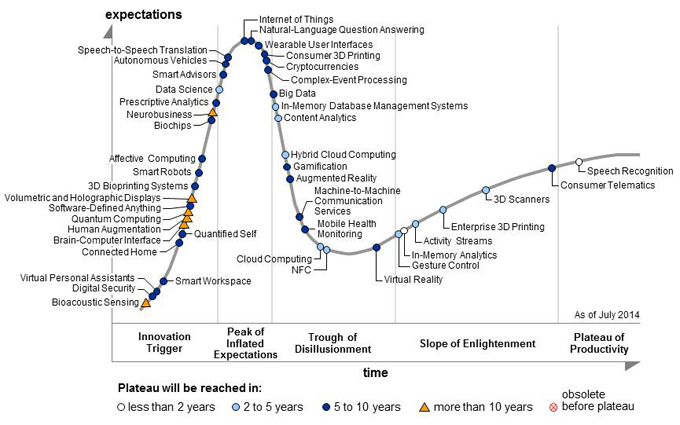
However, there is an alternative view. Its not going to grow the same way because there is no standards body to guide its development.
Equally surprising is the quick quip that IOT is not about the thing or the enterprise, its about content. This line of thought still needs to be developed but its intriguing to me.
Quoting the article of Joe Barkai
We often think of the evolution of the World Wide Web as a model that the IoT will follow. In fact, there is an assumption that with the proliferation of instrumented devices and pervasive commutation, the adoption rate of the IoT will be much faster than that of the Internet. However, the WWW model fostered a culture of collaboration and open standards such as hypertext, HTML and common page browsers; the W3C consortium develops and maintains standards and connects developers and users.
The IOT industry does not seem to converge in this direction; almost the opposite. The space is inundated by numerous of communication standards and data protocols that aren’t interoperable, and companies offering as many one-off solutions to attempt to connect devices using incompatible communications methods and interfaces.
The business potential is not in the conduit, or the “plumbing” of the IoT; it is in the content. (bold emphasis mine)
Subscribe to:
Posts (Atom)